AI consultancy and engineering for real business systems
Production AI. Built on thirty years of engineering.
Put AI to work across your documents, applications and multi-step tasks. We engineer the context, tools, permissions and recovery around each workflow, then test the completed work.
Thirty years of engineering experience helps us spot the dependencies around an AI system, from identity and infrastructure to applications and recovery. Start with the workflow, its test evidence or the way it is operated.
01 / Automate the work
Document & workflow automation
Find information in approved documents, prepare records and reduce repeated handoffs, with people approving consequential changes.
Start with: one process, its inputs and agreed completion checks.
How we structure an AI agent that works inside an organisation. Each layer has a job, an owner and a limit.
People and requests
Verify who or what initiated a request before granting access.
Teams
Email
Web
Voice
How it fails
A request arrives without a verified identity, so the agent cannot tell who it is acting for.
How we control it
Verify the initiating person or service through the channel’s authentication controls. Do not treat an email address or a spoken name as proof of identity.
Agent runtime
Planning, task state and model routing, with attributable identities and explicit authority.
Orchestration
Memory
Model routing
How it fails
Shared credentials and unscoped memory make actions hard to attribute and allow information to cross task boundaries.
How we control it
Give each deployed agent a named owner and attributable actions. Scope memory and tool authority to the task, and record model-routing decisions.
Guardrails
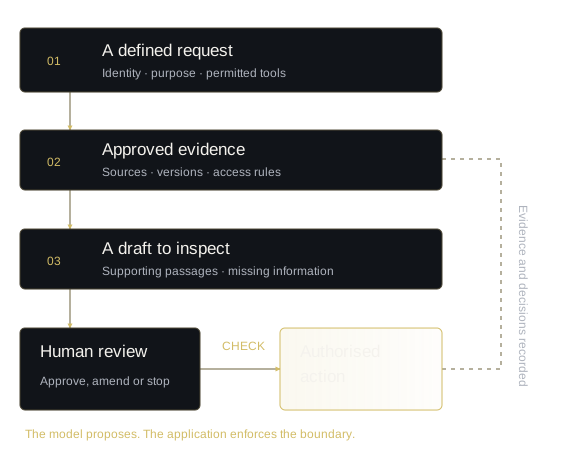
Policy is enforced outside the model. Consequential actions wait for a person.
Policy checks
Approvals
Evaluation
How it fails
Policy lives in the prompt, so a cleverly worded input can talk the model out of it.
How we control it
Policy is enforced by code outside the model, and consequential actions wait for a person to approve them.
Tools
Each tool gets the narrowest credential that works.
MCP servers
APIs
Computer use
How it fails
A tool holds a broad credential, so one manipulated call can reach far beyond the task.
How we control it
Scope each tool’s credentials and validate requests before execution. Check the resource, operation and authority required for the action.
Enterprise systems
Delegated and application access have explicit limits.
Microsoft 365
Line of business apps
Databases
How it fails
Delegated access and application access are confused, so the agent receives authority the task does not need.
How we control it
Delegated calls stay within the signed-in person’s access and the app’s scopes. Application calls use a separately authorised identity, scoped to the resources and operations the task needs.
Evidence
Keep a record of the request, actions and result.
Audit trail
Traces
Cost and quality metrics
How it fails
Something goes wrong and there is no record of what the agent saw, decided or did.
How we control it
Trace the request, retrieved sources, tool calls, cost and result. Apply access and retention controls to the logs, and avoid collecting unnecessary sensitive content.
Reference architecture. Components and controls are selected for the workflow, its risks and the systems in scope.
Bring a document process, a workflow or an AI system you want to improve. We agree the review boundary and the evidence needed to decide the next step.
What you get. A defined scope, prioritised risks and a practical plan for integration, testing and operation.